

Most advice about photography websites is written from memory. This is not. We loaded fifty working photographers’ websites in a real browser on a single day and recorded what was actually there — the page weight, the load time, the number of words, the headings, the pages in the navigation, and whether anyone tells you what anything costs.
Every figure below comes from that one pass, so the sample is identical from row to row. Where a number is small we give the count rather than a percentage.
The short version: these are good-looking, reasonably fast websites that give a search engine almost nothing to work with. The design problem was solved years ago. The comprehension problem was not.
Words On The Page
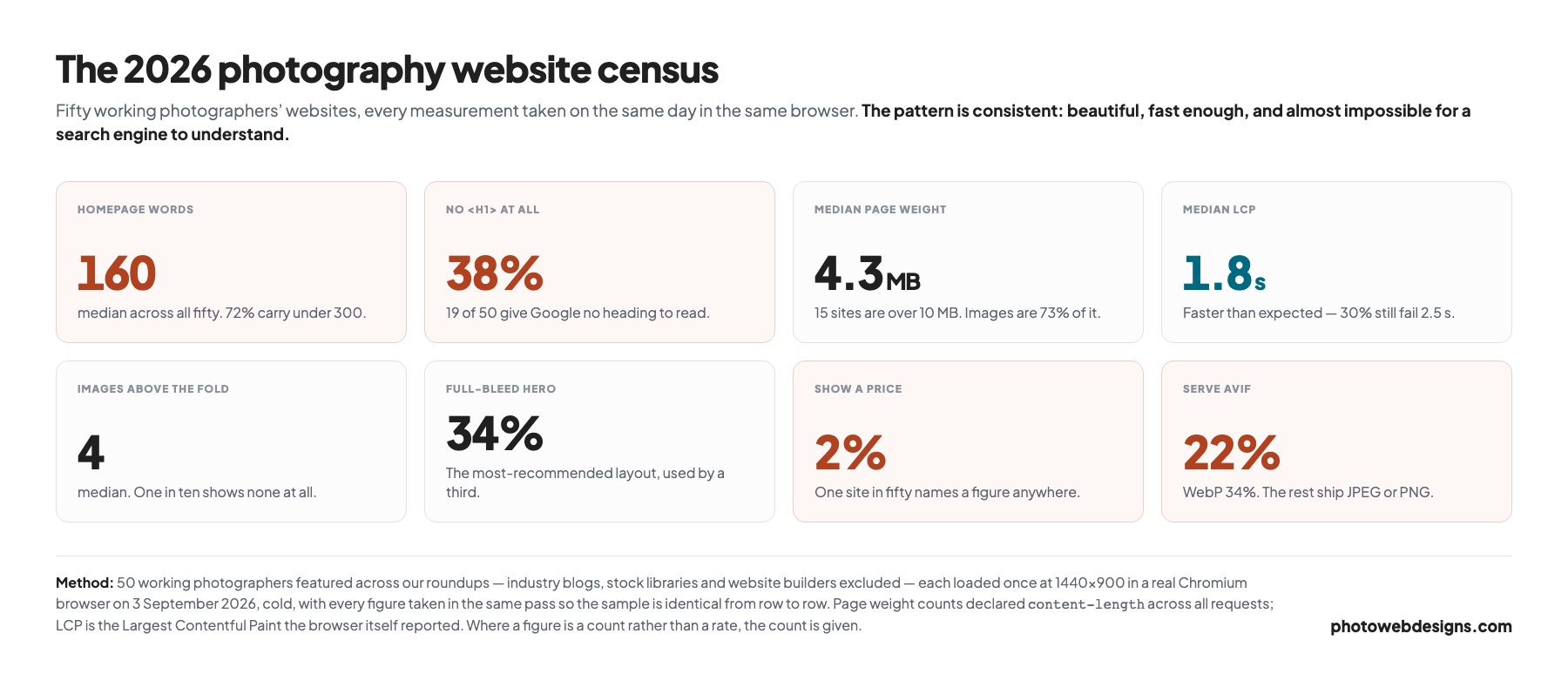
The median homepage carries 160 words in total — the entire page, not the visible part. 36 of the 50 carry fewer than 300.
This is the finding everything else hangs off. A page with 160 words on it usually names no city, no speciality, no price bracket and no service. It is not that these sites rank badly for competitive terms; it is that there is nothing on them to rank for at all. We went into the mechanics of that in why photography websites do not rank.
| Measure | Result |
|---|---|
| Median words on the homepage | 160 |
| Homepages under 300 words | 36 of 50 |
No <h1> anywhere on the page | 19 of 50 (38%) |
| Median words, wedding photographers only | 291 (n=19) |
Word counts are the full rendered text of the homepage. Wedding photographers write consistently more than the rest of the field.
Weight And Speed
Photography websites are heavy, and rather faster than that weight suggests. The median page is 4.3 MB, 21 are over 5 MB and 15 are over 10 MB. Images are the median 73% of it.
Yet the median Largest Contentful Paint is 1.8 seconds on a desktop connection, and only 15 of 50 fail Google’s 2.5-second threshold. Modern hosting and CDNs are absorbing a lot of bad exporting. That is a reprieve rather than a fix — the same pages on a phone on mobile data are a different story, and the fix costs nothing. See how to speed up a slow photography website.
| Measure | Result |
|---|---|
| Median page weight | 4.3 MB |
| Over 5 MB | 21 of 50 |
| Over 10 MB | 15 of 50 |
| Images as a share of page weight | 73% (median) |
| Median Largest Contentful Paint | 1.75 s |
| Fail the 2.5-second LCP threshold | 15 of 50 |
| Serve AVIF | 11 of 50 (22%) |
| Serve WebP | 17 of 50 (34%) |
Measured cold, desktop, one load per site. Page weight is declared content-length across all requests.
What Is Above The Fold
The median homepage shows 4 images before you scroll, and 5 of the 50 show none at all. The full-bleed hero — the single most recommended layout in every guide — is used by 17 sites, or 34%.
More detail on what that first screen should carry is in what a photography website homepage actually needs.
| Above the fold | Result |
|---|---|
| Median images visible before scrolling | 4 |
| No image above the fold | 5 of 50 |
| Full-bleed hero image | 17 of 50 (34%) |
| Contact or booking wording visible | 36 of 50 (72%) |
| A price named anywhere on the page | 1 of 50 |
A site counts as having a hero if an image, video or background image spans the viewport near the top of the page.
Which Pages Exist
Detected from the homepage navigation. Four pages are effectively standard equipment; everything that might differentiate one photographer from another is a minority choice.
| Page | Sites with it |
|---|---|
| Contact | 42 of 50 (84%) |
| About | 37 of 50 (74%) |
| Portfolio or galleries | 36 of 50 (72%) |
| Blog or journal | 23 of 50 (46%) |
| Testimonials | 7 of 50 (14%) |
| FAQ | 5 of 50 (10%) |
| Pricing | 4 of 50 (8%) |
Detected from navigation and link text on the homepage, so a page that exists but is not linked from the homepage will not be counted.
The cliff between the top four and the bottom three is the interesting part, and it is where the competitive advantage sits. We broke it down for one niche in what a wedding photography website actually needs, and looked at the About page specifically in what photographers actually write on their About page.
Nobody Talks About Money
One site in fifty names a price anywhere on the homepage, and 4 have a pricing page at all. This is the most consistent finding in the whole census and the one photographers argue about most.
The argument is usually framed as a binary — publish a price list or do not — and in practice nobody publishes a price list. The handful who quote anything use a starting figure. The full analysis, including what the two service photographers who do publish actually write, is in should photographers put prices on their website.
Design Choices
Most of the trends named in year-ahead lists are minority choices, and several are rarer than the advice implies.
| Choice | Sites |
|---|---|
| Dark background | 8 of 45 |
| Serif display type | 11 of 50 (22%) |
| Video above the fold | 14 of 50 (28%) |
| A scroll-animation library | 9 of 50 (18%) |
Background is the first painted colour behind the page’s own text, so a dark photograph on a white page is not counted as a dark background. Five sites gave no readable background value.
We tested the trend lists against this data in 8 website trends for photographers — the three most confidently predicted turn out to be the three rarest.
It Differs By Niche
The averages hide real differences between the kinds of photography. Wedding photographers write nearly twice as much as the field (291 words against 160), because they are selling to people who have never commissioned photography before. Real estate photographers split into two entirely different website types depending on whether they sell to estate agents or to architects.
The niche breakdowns are here: wedding, fashion, real estate, and the general best photography websites and most popular photography websites roundups.
If You Are Building Or Rebuilding
The census points at a short list of things that are cheap to fix and rare in the field: put an h1 on the page, get the homepage past 300 words without disturbing the design, name where you work, resize your exports, and decide deliberately whether to publish a starting price rather than defaulting to silence.
For the practical side: how to create a photography website, what it costs, which builder to use (or a free one), where to host it, and templates for photography, galleries and WordPress. Platform reviews: Wix, Squarespace and Zenfolio alternatives.
Or, if you would rather it were done for you, that is what we do.
Method, And What This Does Not Cover
Fifty working photographers featured across our roundups, each loaded once at 1440×900 in a real Chromium browser on 3 September 2026, cold. Industry blogs, stock libraries and website builders were excluded before measuring, not after. Every figure in this report comes from that single pass, which is why the sample size is the same in every table.
Its limits are worth stating. Fifty sites is enough to describe a field and not enough to split it finely; where a subgroup is small we have given counts. Everything is desktop and cold-load, so it says nothing about mobile performance or repeat visits. Navigation detection reads the homepage, so a page that exists but is not linked from the homepage does not count. And these are photographers good enough to have been written about — the field as a whole is likely worse, not better.
For a wider survey of different dimensions — domains, fonts, watermarking, social accounts, backlinks — ForegroundWeb’s study of 100+ photographers’ websites remains the most thorough thing written on the subject, and covers a lot of ground this census does not. It was published in 2021, so on performance and image formats in particular the picture has moved since.
Using these figures? Please link back to this page. We intend to re-run the census each year so the numbers stay current.
Frequently Asked Questions
How many words should a photography website homepage have?
The median in this census was 160 words and 36 of 50 sites carried fewer than 300 — which is the main reason so many photography sites are invisible in search. Aim for 400 to 600 words on the homepage; it does not require changing the design.
How fast should a photography website load?
Google’s threshold is a Largest Contentful Paint under 2.5 seconds. In this census the median was 1.8 seconds on desktop and 15 of 50 sites failed it. Page weight matters more on mobile, where the median 4.3 MB page is far more punishing.
How heavy is a typical photography website?
The median was 4.3 MB, with 15 of 50 sites over 10 MB. Images make up a median 73% of that weight, and only 11 of 50 sites serve AVIF, so most of the excess is unresized exports rather than anything structural.
Do photographers put prices on their websites?
Almost never. One site in fifty named a price anywhere on the homepage and 4 had a pricing page at all. Of the handful that publish anything, all use a starting figure rather than a full price list.
What percentage of photography websites have no h1?
38% — 19 of the 50 sites measured had no h1 element anywhere on the homepage. It is usually a logo image sitting where the heading should be, and it is a ten-minute fix.