

Search for advice on writing a photographer’s About page and you will be told, with equal confidence, two incompatible things. That it should run to 150–200 words, and that it should be a few sentences at most. That most bios are written in the third person, and that the third person feels cold and distancing.
None of that is measured. So we opened the About pages of 32 working photographers and counted what is on them.
What 32 About Pages Actually Contain
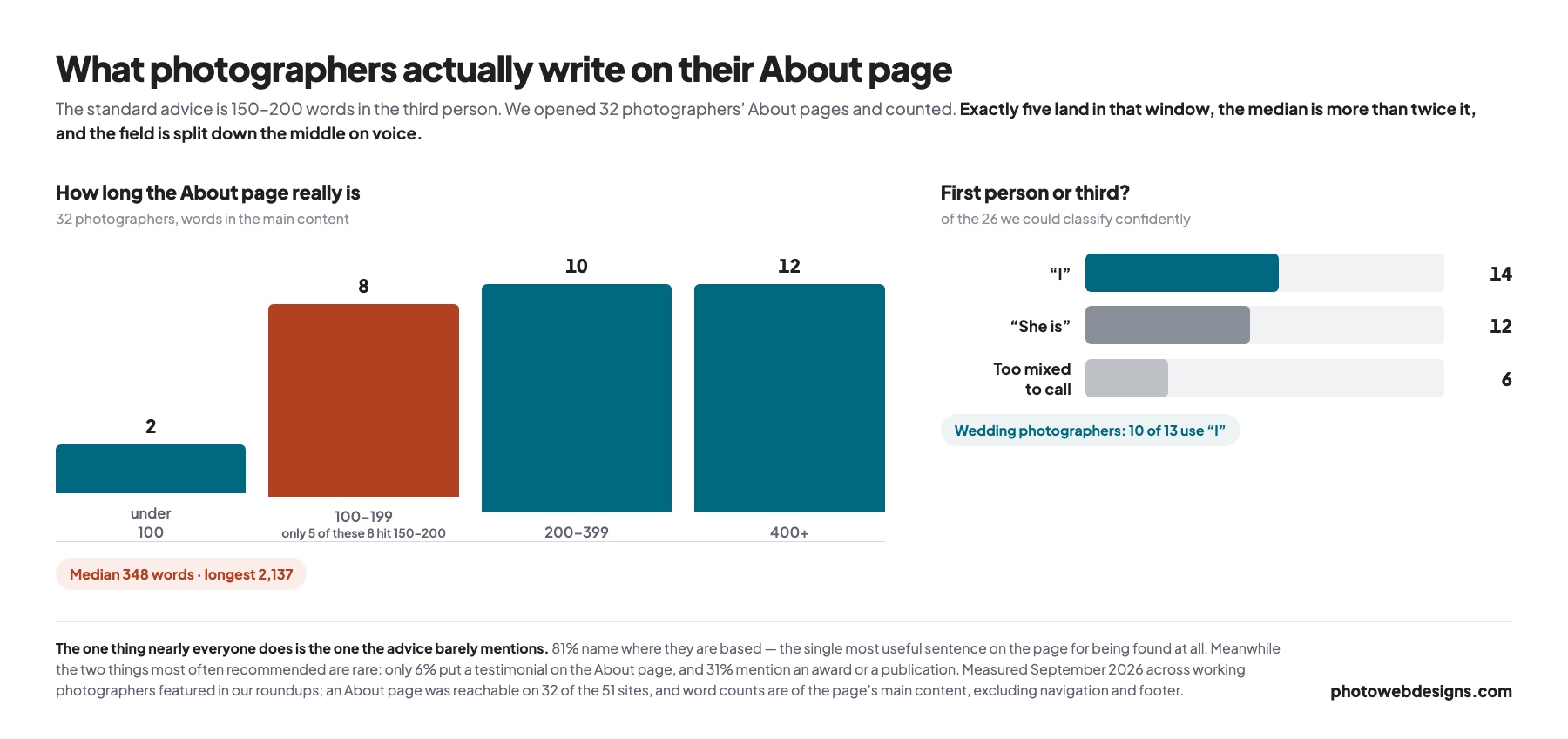
The median About page runs to 348 words, which is roughly double the most commonly repeated recommendation. Only five of the 32 land inside the 150–200 window that advice names, and twelve run past 400. The longest is 2,137 words.
On voice, there is no convention to follow. Of the 26 pages we could classify confidently, fourteen use “I” and twelve use the third person. That is as close to an even split as a sample this size can produce, which means anyone telling you there is a standard is describing a preference.
Length: Write Until You Have Answered The Question
The 150-word rule appears to come from bios — the paragraph you send a magazine — rather than from About pages, and the two are not the same job. A bio establishes credentials. An About page has to move somebody from interested to enquiring.
The pages in our sample that run long are not padded. They are answering questions: how the photographer works on the day, what the process is, how many weddings they take, what happens if it rains. That is why the wedding subset is wordier still, at a median of 376 words. A couple choosing who spends twelve hours with them has more to ask than an art director choosing who shoots a product.
The useful rule is not a word count. It is that every paragraph should answer a question a real client has asked you. If you cannot attach a question to a paragraph, that is the paragraph to cut — whether the page ends up at 150 words or 600.
Voice: Match It To How You Are Hired
The split is not random once you look at who the photographers sell to. Ten of the thirteen wedding photographers in the sample write in the first person. The third-person pages cluster among commercial, editorial and architectural photographers — the ones being commissioned through agencies, where the bio will be lifted and pasted into someone else’s document.
That is the actual rule hiding under the disagreement. Write in the third person if your bio needs to travel — into a press release, a gallery wall label, an agency roster. Write in the first person if the reader is the client, because a couple reading “Sarah is passionate about light” on Sarah’s own website notices, and it reads like a CV rather than a conversation.
If you need both, keep the page in the first person and put a short third-person paragraph at the bottom under a heading like Press bio. That is one extra paragraph and it stops you writing the whole page for the wrong reader.
The Sentence Almost Everyone Writes, And Why It Matters
81% of the About pages we measured name where the photographer is based. It is the single most consistent thing on any of them, and it is barely mentioned in the advice.
It matters for two reasons. The obvious one is that clients need to know whether you are near them. The less obvious one is that for many photographers the About page carries more readable text than the homepage does — we found the median photography homepage runs to 182 words — which makes it one of the few pages on the site that can rank for a place name at all.
If your About page does not currently say what you shoot and where, that is a one-sentence fix with more effect than anything else on this list.
Two Things The Advice Recommends That Almost Nobody Does
Testimonials on the About page — 6%
Several guides suggest putting client quotes on the About page to build credibility. Two of our 32 do it. That is not necessarily a failure of the other thirty: testimonials generally work harder next to an enquiry form, where they answer the hesitation at the moment it occurs. But if your About page is the page people actually land on, it is worth one.
Awards and press — 31%
Ten of the 32 mention an award, a publication or a feature. It is more common among commercial photographers than wedding ones, which fits: an art director recognises the magazine, a couple mostly does not. Name the client or the publication if it means something to your buyer, and leave it out if it only means something to you.
A Structure That Fits What We Measured
Not a template, because the sample does not support one. But the pages that read best in our sample tended to do these things in roughly this order:
- What you shoot and where, in the first sentence. The 81% sentence.
- How you work — the thing a client is really trying to picture. Quiet and observational, or directing everybody? This is what separates you from the photographer whose pictures look similar.
- One genuine specific. Not “I love capturing moments”. Something only you would write.
- A photograph of you. Most of the sample has one and it is a strange thing to omit on the page about you.
- What happens next, with a link to the enquiry form. The About page is where people decide; do not make them navigate back.
If you would rather have someone build and write the page than agonise over it, that is what we do. The same measured treatment for the rest of the site is in what a wedding photography website actually needs and why photography websites do not rank.
Frequently Asked Questions
How long should a photographer’s About page be?
The median in our sample of 32 was 348 words — about double the commonly repeated 150–200 word advice, and only five sites landed in that range. Twelve ran past 400 words. Length matters less than whether each paragraph answers a question a client has actually asked you.
Should a photographer bio be first person or third person?
There is no convention: of the 26 pages we could classify, 14 used first person and 12 used third. The pattern that does hold is by client type — 10 of 13 wedding photographers write in the first person, while third person clusters among commercial and editorial photographers whose bio gets reused in other people’s documents.
What should a photographer About page include?
Start with what you shoot and where you are based — 81% of the pages we measured name a location, making it the most consistent element. Then how you work, one genuine specific, a photograph of yourself, and a link to the enquiry form.
Should I put testimonials on my About page?
Only 6% of the photographers we measured do, despite it being common advice. Testimonials usually work harder beside an enquiry form, where they answer hesitation at the point of decision. Add one to the About page if that is where your traffic actually lands.
Does the About page matter for SEO?
Often more than the homepage. The median photography homepage carries 182 words, so the About page is frequently the only page with enough readable text to rank for a speciality plus a place name. Naming what you shoot and where you work is the highest-value sentence on it.