

There are two settled opinions about putting prices on a photography website, and they contradict each other. One says transparency filters out the tyre-kickers and saves everyone a week of emails. The other says a number without context invites a comparison you will lose, and that the point of the website is to start a conversation.
Both arguments are reasonable. Neither is evidence. So we went and looked at what photographers actually do — 51 working professionals, every one of them good enough to have been featured in a best-of roundup, with each pricing page opened and read.
Three of them tell you what anything costs. It is the most consistent finding in our wider census of photography websites too.
What 51 Photographers Actually Do
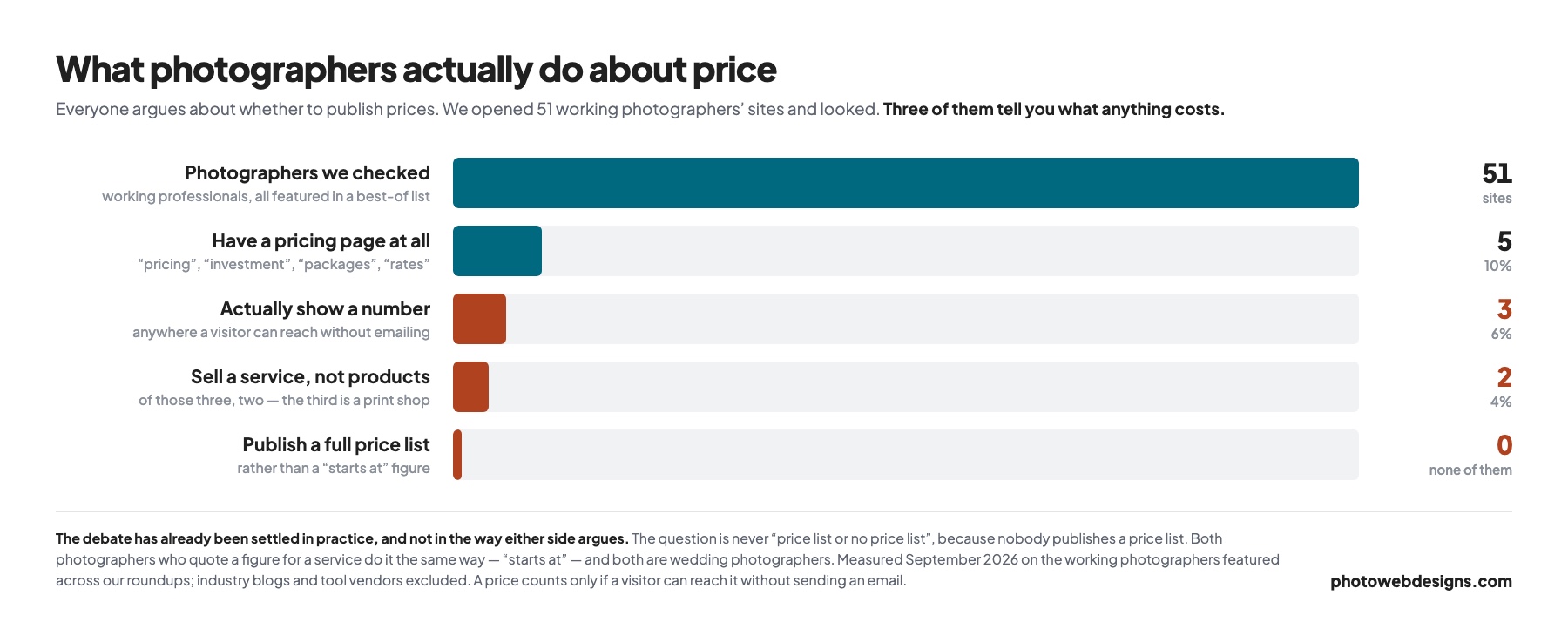
Five sites out of 51 have a pricing page of any kind — a page called pricing, investment, packages or rates. Three of those five put an actual figure on it. The other two are worth describing, because they are the two failure modes nobody warns you about.
One is a fine-art photographer selling limited editions whose prints page says, in full, “for purchase details, contact” and gives an email address. The other is a wedding photographer whose navigation has a prices link that returns a 404. Somewhere along the way the page was deleted and the link was not, so every couple who clicks the one thing they came for lands on an error. That is not a pricing strategy. That is a broken website, and it is the most expensive kind of broken there is.
Nobody Publishes A Price List
This is the finding that makes most of the debate beside the point. The argument is framed as a binary — publish your prices or do not — and not one photographer in the sample publishes a price list. Not one. The three who show numbers all do something narrower.
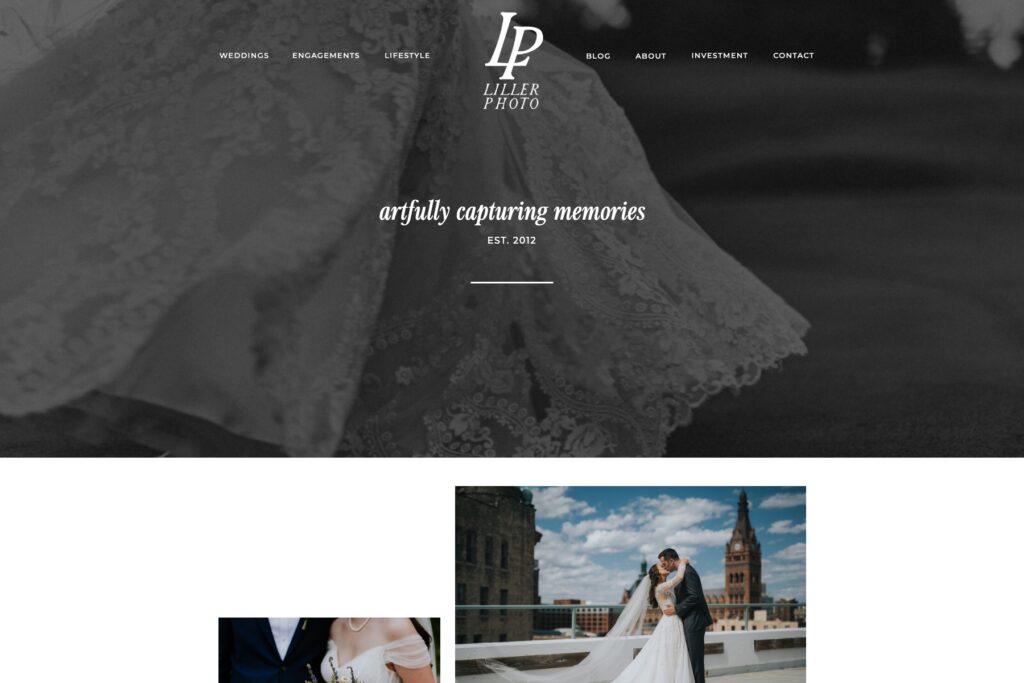
Albert Palmer, a UK wedding photographer, gives three tiers with “starts at £3,000”, “starts at £2,500” and an hourly rate. Liller Photo does the same in dollars: “wedding packages start at $4,000”, with sessions from $375. Both give a floor and stop. Neither publishes what a wedding actually ends up costing, because neither knows until they have spoken to you.
So the real question is not “price list or silence”. It is whether to publish a floor. And on that question the field is almost unanimous: 49 of 51 do not.
The Exception Sells Products, Not Services
The third photographer showing prices is Gray Malin, and he is the interesting one, because his prices are everywhere — on the homepage, on every product, from $49 to $799. He is also not selling the same thing as the other 50.
Gray Malin sells prints. A print is a product: fixed, repeatable, identical for every buyer, and bought without a conversation. A wedding is a service: twelve hours of your one irreplaceable day, priced on date, distance, hours and how many people need feeding. Products get price tags. Services get proposals. That is not photographers being coy, it is how every service business on earth works, and it is why the retail-transparency argument does not transfer.
If you sell prints, presets, albums or downloads, price them plainly and stop thinking about it. If you sell your time, you are in the other category, and the honest version of the question is how much of a hint to give.
What To Actually Do
The case for a starting figure is stronger than the 4% adoption rate suggests, and it rests on something the “start a conversation” argument quietly ignores: a conversation you are never invited to have is not a conversation. A couple with a £1,200 budget who cannot tell whether you are £1,500 or £6,000 does not email to find out. They move on, and you never learn they existed.
That is the asymmetry. Hiding the number does not win you the enquiry from someone who cannot afford you. It loses you the enquiry from someone who can but assumed otherwise.
If you shoot weddings or commissioned work
Publish a floor, in the format the two photographers who do it already use: “collections start at £2,400”. It does the filtering, it costs you no negotiating room, and it does not commit you to a menu. Put it on a page called Investment or Pricing and link it from the main navigation, because that is the word people look for.
If you genuinely cannot publish a number
Say so, in one sentence, and say what happens instead. “Every wedding is quoted individually — most couples spend between X and Y” is still a number. “Contact for pricing” on its own reads as expensive, and the people it puts off are not only the ones you wanted to put off.
If you sell prints or products
Price them like a shop, because that is what you are running. There is no version of this debate that applies to a $49 print.
Whatever you choose, click the link
One in five of the pricing pages we tried was broken. Whatever you decide to say about price, make sure the page saying it still loads.
If you would rather someone else built the page — and made sure it kept working — that is what we do. The measured version of what belongs on the rest of the site is in what a wedding photography website actually needs, and the cost of building one is in our photography website cost guide.
Frequently Asked Questions
Should photographers put prices on their website?
Most do not — only 3 of the 51 working photographers we measured show a price anywhere a visitor can reach. But the two who sell a service both publish a “starts at” floor rather than a full price list, and that is the option worth considering. A starting figure filters enquiries without committing you to a fixed menu.
What percentage of photographers show their prices?
In our sample of 51, 10% had a pricing page and 6% showed an actual number. Among wedding photographers specifically, none showed a price on the homepage and 2 of 19 published a figure anywhere on the site.
Should I show a full price list or a starting price?
Nobody in our sample published a full price list. Both photographers who quote for a service use a starting figure — “starts at £3,000” or “packages start at $4,000”. A floor does the filtering work without pinning you to a menu you will want to vary.
Does hiding prices lose you clients?
It can, in a way that is invisible to you. Someone who cannot tell whether you are affordable usually leaves rather than asking, so you never see the enquiry you lost. That is the asymmetry: hiding the number does not stop the wrong enquiries so much as prevent the right ones.
Where should the pricing page go?
In the main navigation, labelled Pricing or Investment — those are the words people look for. And test the link: one in five of the pricing pages we tried was broken, including one that returned a 404 on a wedding photographer’s only prices page.