

Every guide to wedding photography websites names the same four pages: a homepage, an about page, a portfolio and a contact page. It is sensible advice. It is also, as far as we can tell, advice that nobody needs.
We checked 19 working wedding photographers’ websites — the ones featured across our best wedding photographer websites roundup — and looked at what each one actually has. All 19 have a contact route. Sixteen have a portfolio. Fifteen have an about page.
If almost everyone already has the four essential pages, those four pages cannot be what separates the photographers who get booked from the ones who get browsed. So we went looking for what does.
What 19 Wedding Photography Websites Actually Contain
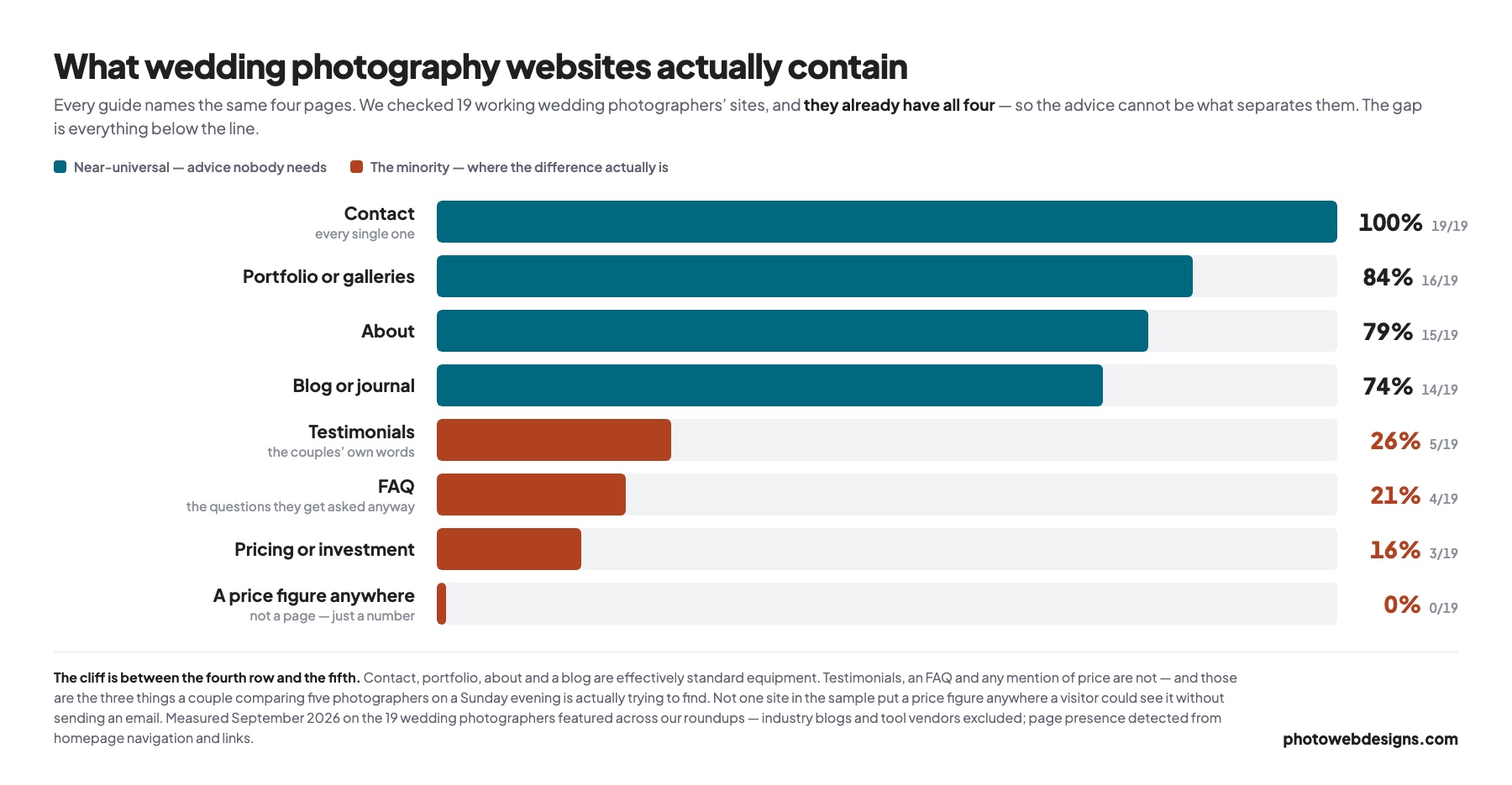
There is a cliff in that chart, and it sits between the fourth row and the fifth. Everything above it is standard equipment. Everything below it is a minority choice — and it is the half a couple is actually trying to find.
The Four Pages Everyone Already Has
Briefly, because there is not much to say about advice that has already been taken:
| Page | Have it | Worth knowing |
|---|---|---|
| Contact | 19 / 19 — 100% | Universal. What varies enormously is how easy it is to reach from the homepage. |
| Portfolio or galleries | 16 / 19 — 84% | The three without one put the work directly on the homepage instead, which is a legitimate choice. |
| About | 15 / 19 — 79% | For a wedding photographer this is closer to a sales page than a biography. Couples are hiring a person to spend twelve hours with them. |
| Blog or journal | 14 / 19 — 74% | Higher than photography generally. Full wedding stories are how wedding photographers rank for venue names. |
If you are missing one of these four, add it. But adding it will make you normal, not distinctive.
The Four Things That Actually Separate Them
1. Testimonials — 26% have them
Five of the 19 show what previous couples said about them. That leaves fourteen asking a stranger to hand over several thousand pounds and the only record of their wedding day, on the strength of photographs alone.
Photographs prove you can shoot. They cannot prove you were calm when the ceremony ran forty minutes late, or that the album arrived when you said it would. Only somebody else’s words do that, and a wedding is bought largely on trust.
What to do: three or four specific quotes beat twenty generic ones. “She kept everyone calm when the rain started” is worth more than “amazing photos, highly recommend”. Put them near the enquiry form rather than on a page of their own, where almost nobody will go looking.
2. An FAQ — 21% have one
Four of 19. Which is odd, because every wedding photographer answers the same questions by email several times a week: how many hours, do you travel, when do we get the photos, what happens if you are ill, do you have insurance, do we feed you.
An FAQ page is the cheapest page on this list to write, because you have already written it — it is sitting in your sent folder. It also happens to be the page most likely to be quoted back by a search engine answering someone’s question directly.
What to do: go through your last twenty enquiry threads and write down every question asked more than once. That is your FAQ, in the couple’s own language rather than yours.
3. A pricing page — 16% have one
Three of 19. And not one site in the sample put an actual number anywhere a visitor could see it without sending an email.
This is the most defensible omission on the list, and the one worth thinking hardest about. The argument for hiding price is real: you want the conversation, and a number without context invites a comparison you will lose. The argument against is equally real, and it is that couples filter on budget first, and a photographer with no price is easy to leave out of the shortlist entirely.
What to do: a starting figure is usually enough — “collections begin at £2,400” — and it does most of the filtering work without pinning you to a menu. If you genuinely cannot publish one, say why in a sentence and say what happens instead. Silence reads as expensive; an explanation reads as considered. We looked at what photographers actually do about price across 51 sites — only three publish a figure, and not one publishes a price list. Our guide to what a photography website costs covers the same reasoning from the other side of the transaction.
4. A way to capture an email — 16% have one
Three of 19 have any form of email capture beyond a contact form. Most couples visiting your site are eleven months from booking and will not enquire today. Without something to keep the connection open, that visit is gone.
What to do: a pricing guide or a short planning PDF in exchange for an email is the standard move, and it works precisely because it answers the question the pricing page did not.
Wedding Photographers Write More Than Other Photographers
One number surprised us. The median wedding photography homepage in our sample carries 294 words. Across photography sites generally — fashion, commercial, landscape, portrait — the median homepage carries 169.
Wedding photographers write nearly twice as much, and they are right to. A commercial photographer is being hired by an art director who can read a portfolio in fifteen seconds. A wedding photographer is being hired by two people who have never commissioned photography before, are spending more than they expected, and need to be reassured as much as impressed.
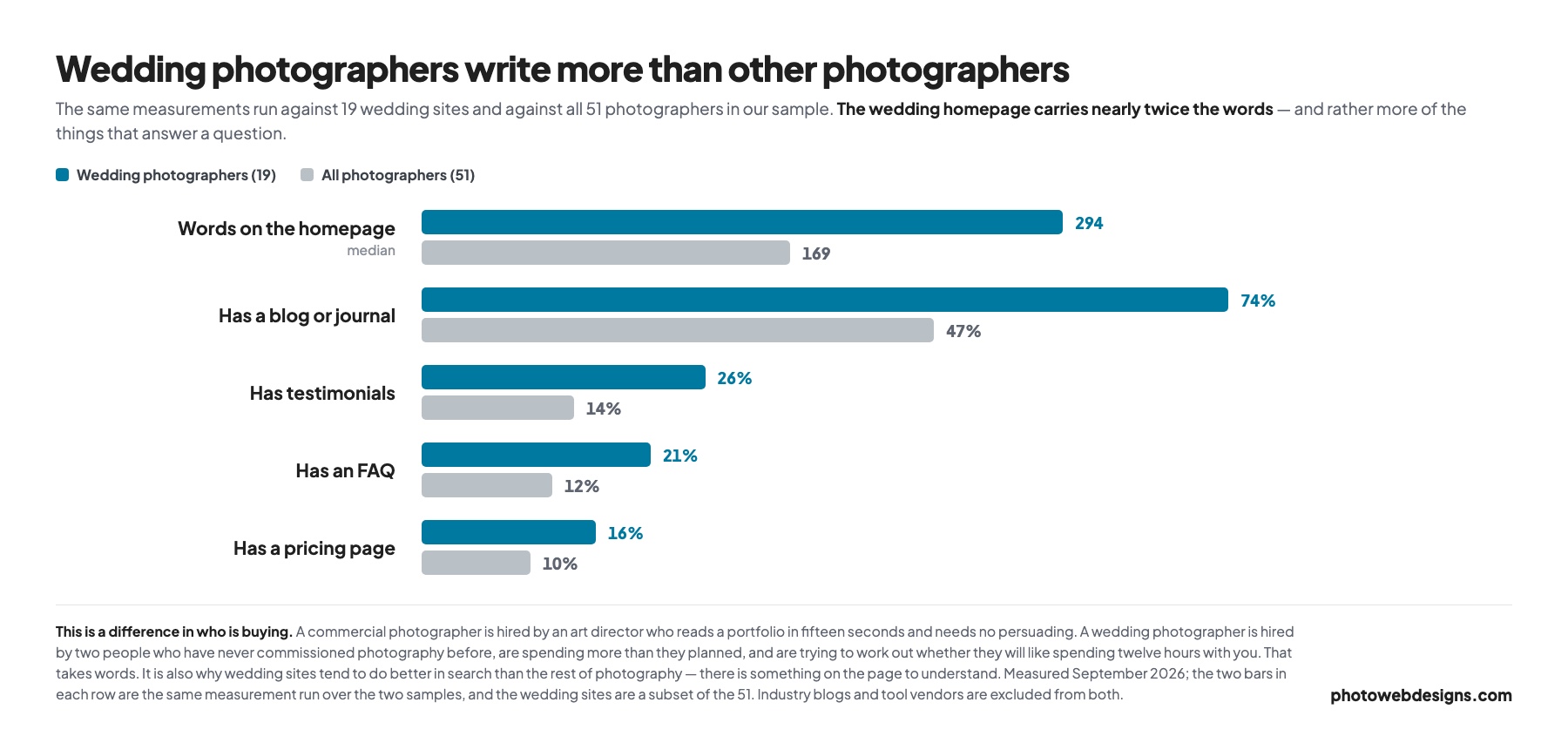
That extra writing is also the reason wedding sites tend to do better in search than the rest of photography: there is something on the page for Google to understand. If you shoot weddings and your homepage is a grid of images with nine words on it, that is the gap.
The Order To Build Them In
If you are starting from nothing, or rebuilding, this is the sequence that gets you booked soonest rather than the one that gets you finished soonest:
- Homepage with real words on it. Who you are, what you shoot, where you are based. The measured version of what belongs here is a separate piece.
- Contact, reachable from the fold. Half of all photography homepages make you scroll before you can enquire.
- Portfolio, edited hard. Complete weddings beat a highlight reel of forty different ones — couples want to see a whole day handled.
- About, written like a person. This is the page that converts, and it is the one most often written in the third person for no reason.
- A price, or an explanation of why there is not one.
- Testimonials, placed next to the enquiry form.
- An FAQ, copied out of your sent folder.
- A blog, but only if you will keep it. An abandoned journal with three posts from 2023 is worse than none.
The first four are table stakes. The next three are where the 19 sites we measured differ from one another, which makes them the ones most likely to differ for you.
If you would rather not build it yourself, this is what we do — see website design for wedding photographers.
Frequently asked questions
What pages should a wedding photography website have?
At minimum a homepage, portfolio, about page and contact page — but all 19 sites we measured already have those, so they will not set you apart. The pages that actually differ between photographers are testimonials (26% have them), an FAQ (21%) and pricing (16%).
Should wedding photographers put prices on their website?
None of the 19 sites we measured shows a price figure anywhere. There are real arguments both ways, but a starting figure — “collections begin at…” — does most of the filtering work without committing you to a fixed menu, and stops you being cut from a shortlist for being unknowable.
How long should a wedding photography homepage be?
The median wedding photography homepage in our sample carries 294 words, about twice the 169-word median across photography generally. Couples are commissioning something expensive and unfamiliar, and they need reading material, not just pictures.
Do wedding photographers need a blog?
74% of the sites we measured have one, and full wedding stories are how photographers rank for venue names, which is a genuinely valuable search term. But a blog abandoned after three posts is worse than no blog. Only start one you will keep.
What is the most commonly missing page on a wedding photography website?
A pricing page, missing from 84% of the sites we checked, followed by an FAQ, missing from 79%. Both are cheap to produce and both answer questions couples are asking anyway.